Free stuff
Metrics in general
- Different levels of the organization should be looking at very different metrics. Understand who should be looking at what.
- Goodhart’s Law says that “when a measure becomes a target, it ceases to be a good measure.” Many people struggle with this one.
Measuring flow metrics
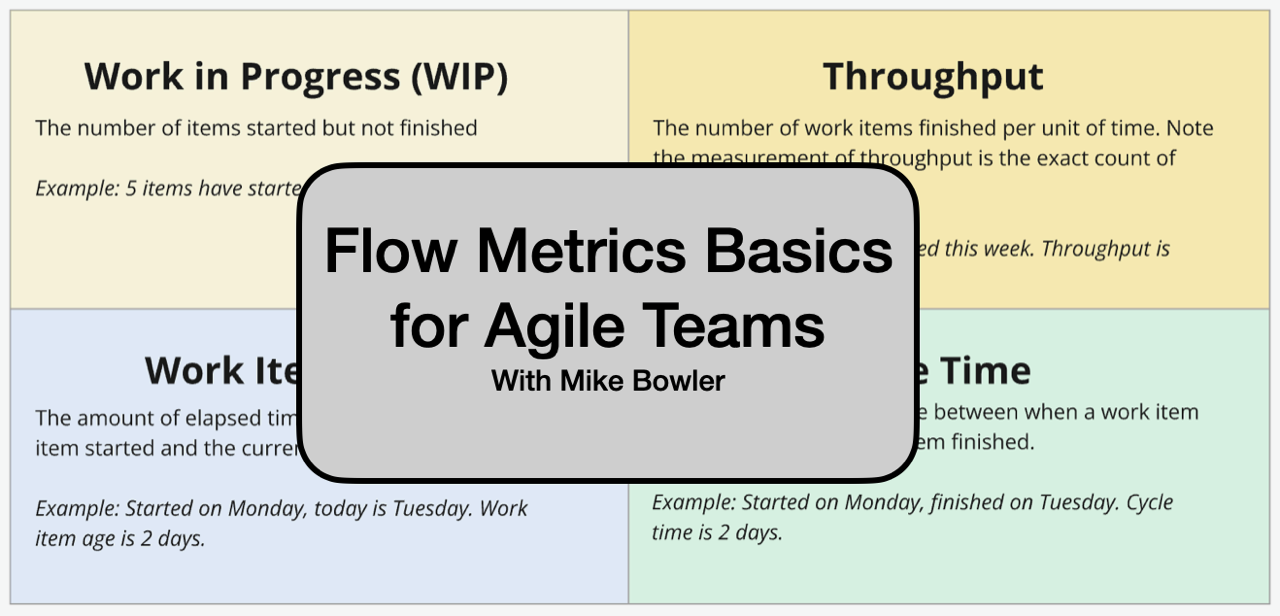
- Understanding basic flow metrics of Cycletime, Throughput, Work In Progress (WIP), and Work Item Age
- Understanding flow efficiency, a very powerful metric that’s rarely used because of the difficulty in measuring it.
- In order to measure any of the basic flow metrics, we need a clear definition of the start and end points
- Common problems with flow metrics
- We often start collecting data before we even know what we want to do with it.
- We often collect the wrong data
- We often misinterpret what’s there
- We focus on keeping people busy instead of optimizing for any of effectiveness, efficiency, or predictability.
- We don’t slice the work well and this skews the data. See how to slice stories or slice epics
Gaming metrics
- If people know that a thing is being measured, they’ll change their behaviour to ensure that measurement makes them look good. Sometimes the result of that behaviour change is so wildly different from the desired outcome, that it causes other problems. That’s a perverse incentive.
Metrics from Jira
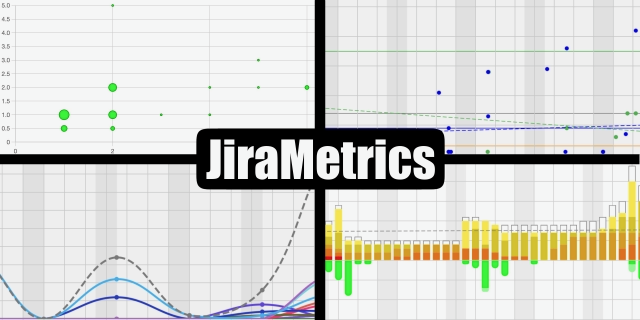
You should really use an existing tool to extract metrics from Jira, like my own JiraMetrics, but if you really want to do it yourself, I’ve documented the API’s I use.
When will we be done?
When trying to answer the question “when will we be done?”, we often try to estimate how big the individual work items are, and this is complete waste. What we want to do instead, is to create a probabilistic forecast. In a nutshell, an estimate is a made up number based on how we feel about complexity, and a probabilistic forecast is a far more accurate mathematical calculation based on historical data. It’s time for estimates to go away.
Part of having an accurate forecast is ensuring that the data itself is inherantly predictable and there are specific things we can do, to improve that prodictability.
Once we have that forecast, we need to understand the cognitive biases that make us trust it less, even though it’s more accurate. If we want to make better decisions, we need to understand our own biases.
| Article | Date |
|---|---|
| Cumulative flow diagrams (CFD) | March 27, 2026 |
| Why people don't use Monte Carlo | February 27, 2026 |
| Collecting metrics for no reason | December 16, 2025 |
| Gaming metrics | July 23, 2025 |
| Jira Metrics 2.12 | July 14, 2025 |
| Wait states | May 7, 2025 |
| Basic Flow Metrics | November 21, 2024 |
| Visualizing Flow Efficiency | October 5, 2024 |
| Tracking metrics | July 15, 2024 |
| Flow Efficiency | July 6, 2024 |
| One Thing vs Multiple Things | June 3, 2022 |
| Improving Predictability - Consistent Units and Conclusion | September 16, 2021 |
| Improving Predictability - Average Age | September 15, 2021 |
| Improving Predictability - All work must finish | September 14, 2021 |
| Improving Predictability - Average Arrival and Departure Rates | September 13, 2021 |
| Improving Predictability | September 12, 2021 |
| Determining cycle time from an online system | May 18, 2021 |
| Improve the work, not the metrics | April 14, 2021 |
| The three flow metrics (plus one) | April 12, 2021 |