
In the spirit of improving how we think, let’s consider a mental model I was working with that turned out to be almost completely wrong.
I run across teams who really seem to understand agile. They’ve read the books. They can tell you exactly why we work in small batches. They’ll argue about it over a drink.
Then I sit in on their daily scrum and watch them follow the old three questions while other team members disengage. I watch them follow the Connextra story format (“As a [role], I want to [action] so that [reason]”) without questioning whether it’s made the description useful or not. I listen to people say no blockers when clearly they have blockers, and they can’t hear the disconnect in their own words.
These behaviours that I’m seeing are often referred to as cargo culting1, where we follow the form without thinking about whether we get any value out of it.
This is where we come to my incorrect mental model. I assumed that this was largely a motivation problem. I thought that the more motivated we were (further right on the diagram), the more we would care about being effective, rather than just following the routine.
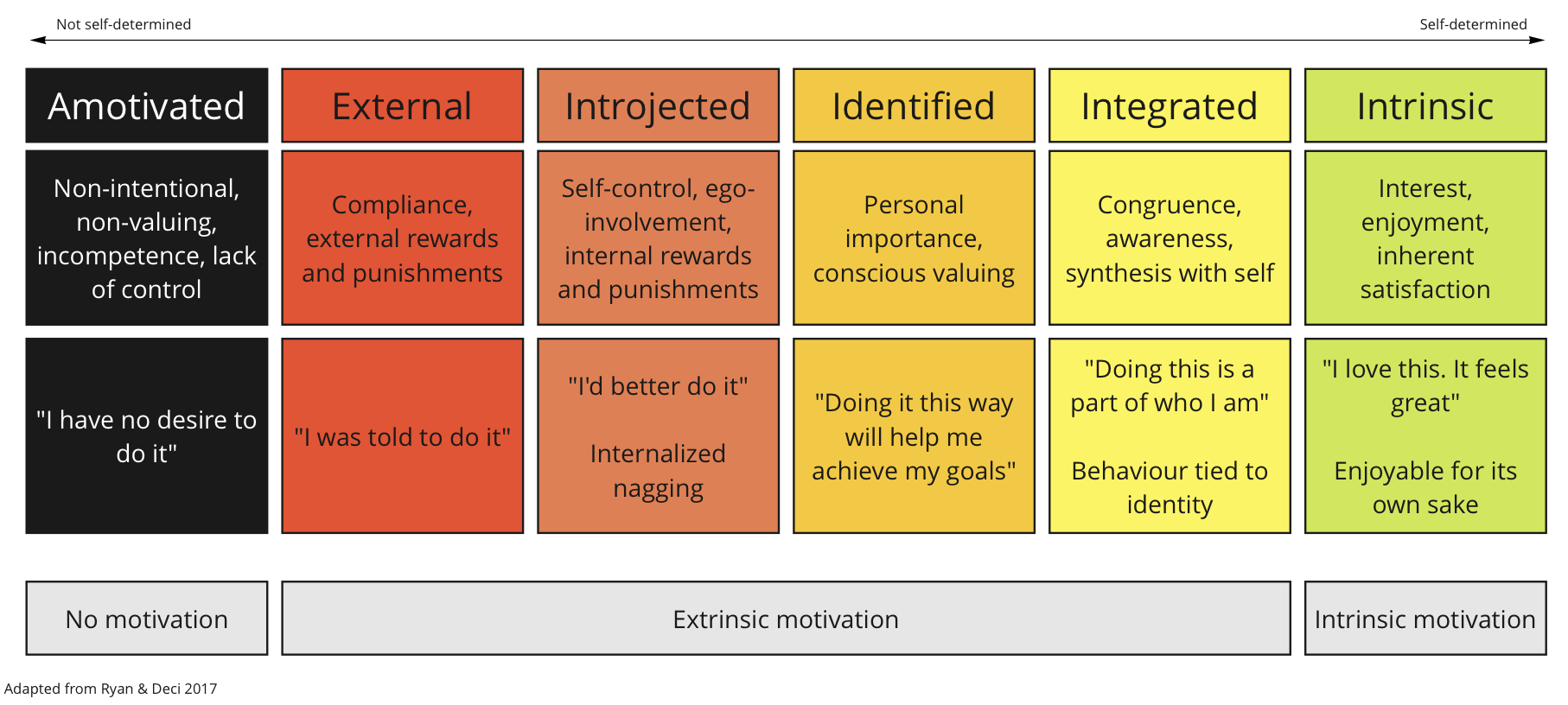
Then I found some research that proved me wrong.
Tanja Elina Havstorm spent three years embedded with three software teams at a manufacturing company in Sweden, watching how they actually used their agile practices.2 She catalogued 36 deviations across the daily scrum, the sprint demo, continuous integration, and visualization.
She classifies every action she saw three ways: what kind of action it was, whether the reasoning behind it succeeded, and what motivated it. That gives us eight patterns, five of which are cargo culting.
| Pattern | Action | Reasoning | Motivation | Cargo culting? |
|---|---|---|---|---|
| Achievement | Means-end | Rational | External | No |
| Accomplishment | Means-end | Rational | Internalized | No |
| Credence | Value-based | Rational | Internalized | No |
| Fragmental | Means-end | Irrational | External | Yes |
| Deficient | Means-end | Irrational | Internalized | Yes |
| Conception | Value-based | Irrational | Internalized | Yes |
| Conventional | Traditional | Non-rational | Amotivated | Yes |
| Spontaneous | Affectual | Non-rational | Amotivated | Yes |
Compare the last two columns. Motivation doesn’t line up with cargo culting at all; internalized motivation appears twice in the healthy patterns and twice in the broken ones. Reasoning lines up perfectly.
The autonomous end of the scale, the end I expected to protect us, appears in both groups. It’s in the healthy patterns, where teams have taken the values on board and act accordingly. It’s also in the broken ones. She calls one of those deficient.
“The SDM goals are not perceived as a controlling factor. Instead, they have been fully assimilated by the software developers, i.e., internalized regulated.” Tanja Elina Havstorm, “Cargo Cult in Agile Software Development”2
Those are the behaviours I described at the top. Nobody was reciting the three questions because a manager was watching. They’d taken the goals on board, and the standup was still broken.
External motivation tells us just as little, and it appears in both groups too. A team that was told by management to run a practice can run it perfectly well, without thinking through whether it makes sense.
Being motivated doesn’t mean we’re doing it properly.
There is one place where my instinct held up. The far left of the model is bad every time. Both of the amotivated patterns are cargo culting, and there’s no healthy version of either. Those are the teams running on old habits, or on whatever the industry is excited about this year. In one of her examples, the manager roles survived the transition intact and were simply renamed as Scrum Masters.
Her early framework had intrinsic motivation in it and she had to take it out, because across three years of watching real teams she couldn’t find any. The far right of the model was empty.
Her own definition of the phenomenon uses the word unconsciously.3 Nobody in these teams knew they were doing it, and that isn’t a criticism of them. A team that was aware of the problems would probably have fixed them already.
My mental model around this was completely wrong and it wasn’t until I stumbled across this research that I even thought to question it. How many other mental models that we regularly count on are also wrong?
-
The term cargo culting refers to copying the visible form of a practice while missing whatever made it work. It reached software through Richard Feynman, who coined “cargo cult science” in a 1974 address at Caltech. It is a poor term, loaded with racism and colonialism, coined by colonial administrators to dismiss Melanesian religious movements as irrational mimicry. Lamont Lindstrom unpacks that history if you want it. I use the term here because it is what both the research and our industry call this. ↩
-
Havstorm, T. E. (2023). “Cargo Cult in Agile Software Development”, doctoral dissertation, Örebro University. The motivation model is taken from Gagné, M., & Deci, E. L. (2005), “Self-Determination Theory and Work Motivation”, Journal of Organizational Behavior, 26(4), pages 331-362, which adapts SDT for studying groups rather than individuals. ↩ ↩2
-
Her full definition: “A software development method cargo cult is a temporarily-delimited dysfunction, resting on the foundation of lack of intended reasons. It leads to misconceptions and/or malpractices that are driven by the collective motive as they unconsciously fail to replicate the circumstances and success of others.” ↩