
After a forest fire has passed, some trees will be left standing but scorched from the fire. Others, however, will have disappeared entirely. Sometimes the trunk and then the roots will continue to smolder until there is nothing left but ash, and then with some rain, even the ash will disappear.
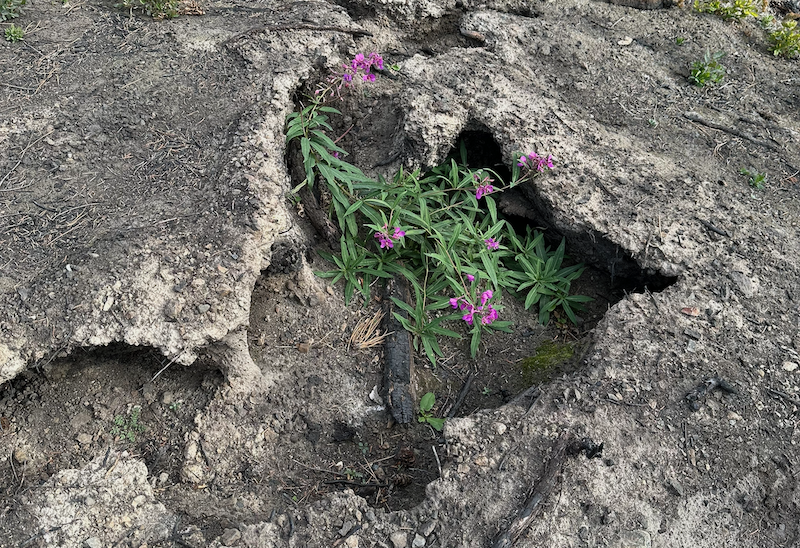
This leaves us with a hole in the ground, in the shape of a tree. Tunnels where the roots used to be but with no obvious reason to be present. If you hadn’t known that a fire had come through, you wouldn’t understand why this hole was there or what the tunnels were for.
This particular picture was taken a year after a forest fire had raged through the Kelowna area, where I live. All that’s left is the hole, although you can see that nature is returning and that some flowers are now growing where the tree used to be.
Organizations leave the same kind of imprints. When a process, a system, or a person is removed, the shape of what was there often remains as review steps that nobody questions, signoffs that slow everything down, and manual steps that everyone agrees are unnecessary but nobody is willing to automate.
The most common cause I’ve seen is some kind of production outage. Something goes wrong, people panic, and a gate gets added. A mandatory sign-off. A required review. A checklist before deployment. These gates are designed to prevent that specific thing from ever happening again, and in the immediate aftermath they make good emotional sense (although often not logical sense).
The problem is that they’re rarely revisited. The incident fades from memory, the people involved move on, and the gate remains, and nobody remembers why.
Sometimes the gate was never really about the risk at all. It was about a specific person who got burned, or who got yelled at by their boss. The process existed, in part, to protect them. When they leave, the emotional logic of the process leaves with them but the hole remains.
I was once in a meeting of senior people at a bank, discussing whether physical signatures on paper forms could be replaced with electronic ones. The legal team had already weighed in: electronic signatures provided just as much legal protection as the physical ones, and yet nobody in the organization was willing to sign off on dropping the physical signature requirement. There was too much personal risk for the person who would make that decision.
If you remove the requirement and nothing goes wrong, nobody notices. However, if you remove it and something goes wrong, you are now the person who removed the safeguard. The fact that the safeguard wasn’t actually providing any protection is irrelevant to your career. So the rational move for each individual person is to leave it in place; even when everyone in the room agrees it serves no purpose.
This is how imprints persist.
If you’re experiencing unexplained friction in your organization, steps that feel like they shouldn’t be there, approvals that nobody can justify, processes that seem to exist for their own sake, it’s worth asking what used to be there. There’s usually a hole in the ground. Sometimes there’s a tree still smoldering. And occasionally, if you look carefully enough, you can find someone who remembers the fire.
If you’re in a position to remove these imprints, the good news is that in my experience it rarely backfires. The processes are usually not doing what people think they’re doing. The harder problem is getting anyone to accept the personal risk of being the one who removed the safeguard. That often requires someone with enough organizational authority to absorb the risk, or enough credibility to make the argument that the risk was never real to begin with.
The flowers in that photograph are growing where the tree used to be. Nature isn’t sentimental about the hole, and we shouldn’t be either.